Showing posts with label mirepoix. Show all posts

Wednesday, May 21, 2014

Double Chicken Broth from Culinary Fundamentals

Notes: VARIATION:

Chicken Noodle Soup: Dice or shred the reserved chicken meat and add it to the broth along with 6 ounces of cooked corn (fresh or frozen), 6 ounces of cooked egg noodles, and 2 ounces of chopped parsley.

Categories: Soup

Source: Culinary Fundamentals
Copyright: Prentice Hall


Ingredients:

3 pounds Stewing hen
2 quarts Chicken Stock
2 teaspoons Salt
6 ounces Mirepoix, medium dice
4 ounces Tomato concassé
1 each Sachet d'epices
1/2 teaspoon Salt
1/4 teaspoon Black pepper, freshly ground


Process:

1. Cut the stewing hen into quarters.

2. Place the chicken in a stock pot and add the stock and salt. The stock should cover the chicken by at least 2 inches. Bring the chicken and stock to a simmer over medium heat. Reduce the heat slightly and continue to simmer, skimming the surface as necessary, for 2 hours.

3. Add the mirepoix and tomatoes and simmer for 30 minutes.

4. Add the sachet to the broth and continue to simmer until the chicken is fully cooked and tender and the broth has a rich flavor and good body, another 30 to 40 minutes.

(Note: Remove the chicken from the broth when fully cooked and tender (the breast portions may complete cooking before the thighs) and pull the meat away from the bones. Discard the bones, skin, and tendons. Reserve the meat to use as a garnish for the broth or for other applications.)

5. Taste the broth and adjust the seasoning with salt and pepper. Strain the broth through a fine wire mesh sieve or cheesecloth.

6. Degrease the broth if necessary. It is ready to serve now, use as an ingredient in another dish, or it may be properly cooled and stored for a later use.


Chicken Stock from Culinary Fundamentals

Yield: 1 gallon

Notes: Replace 2 pounds of the chicken bones with turkey necks for an extra rich, gelatinous stock.

Add to the aromatic ingredients suggested here or replace them with other ingredients to achieve a particular flavor. Options for a specific flavor in the finished stock include: sliced fresh ginger, lemongrass, fresh or dried chiles, strongly flavored herbs, such as tarragon or rosemary, mushroom stems.

Using a prepared stock or rémouillage gives stocks greater body and flavor. These stocks are sometimes known as double-strength.

Categories: Soup

Source: Culinary Fundamentals
Copyright: Prentice Hall

Ingredients:

8 pounds Chicken bones, cut into 3-inch lengths.
6 quarts Cold water
1 pound Mirepoix, medium dice
1 each Sachet d'épices


Process:

1. Rinse the bones under cool running water and place in a stockpot.

2. Add cold water to cover the bones by about 2 inches. Bring the stock to a boil. Skim the surface as necessary. Reduce the heat and continue to simmer for 3 to 4 hours.

3. Add the mirepoix and sachet and continue to simmer the stock 1 or 2 more hours, skimming as necessary and tasting from time to time. Strain the stock through a sieve or a colander lined with rinsed cheesecloth. The stock may be used at this point, or it may be properly cooled, labeled, and stored.


Beef Stock from Culinary Fundamentals

Yield: 2 quarts

Categories: Soup

Source: Culinary Fundamentals
Copyright: Prentice Hall

Ingredients:

1 fluid ounce Vegetable oil
4 pounds Beef hind shank, cut crosswise
3 quarts Cold water
2 teaspoons Salt
8 ounces Mirepoix, medium dice
4 ounces Tomato concassé
1 each Sachet d'epices


Process:

1. Preheat oven to 375°F. Pour the oil into a half sheet pan or roasting pan and place the pan in the oven. When the oil is hot, after about 5 minutes, add the beef shank pieces to the pan and roast, turning brown all sides evenly, 30 minutes. (Note: Roasting the beef is optional, but contributes a rich color and flavor in the finished broth.)

2. Put the beef shank pieces into a stock pot and add the cold water. The water should cover the bones by about 2 inches. Add the salt and bring to a simmer over medium heat. Reduce the heat to establish a gentle simmer. Skim the surface with a skimmer or a spoon as necessary throughout simmering time. 

3. While the broth comes to a simmer, add the mirepoix and tomato concassé to the same pan used to roast the bones and return to the oven. Roast until the onions are golden and the tomatoes have a rich, sweet aroma, 15 to 20 minutes. After the broth has simmered for 2 hours, add the roasted vegetables to the pot. Add a ladle full of the broth to the roasting pan and stir well to release any drippings. Add these to the pot as well. Continue to simmer for another hour.

4. Add the sachet to the broth after it has simmered a total of 3 hours and continue to simmer until the broth is richly flavored with a good body, another hour. Taste and adjust the seasoning with salt and pepper is necessary.

5. Strain the broth through a fine wire mesh sieve or cheesecloth. It is ready to serve now, use as an ingredient in another dish, or it may be properly cooled and stored for later use.

Wednesday, September 26, 2012

Roast Chicken with Pan Gravy

Roast Chicken with Pan Gravy 


Servings: 10 
Categories: Main Dish 
Source: Culinary Fundamentals Copyright: Prentice Hall


5 each Chickens
Salt, as needed
Black pepper, as needed, freshly ground
5 each Thyme sprigs
5 each Rosemary sprigs
Vegetable oil or butter, as needed

Mirepoix
4 ounces Onion, diced
2 ounces Carrot, diced
8 ounces Celery, diced

Pan gravy
2 ounces Flour
1/2 ounce Tomato paste (optional)
1 pint Chicken Stock, hot


1. Remove the wing tips from the chickens and reserves. Season the exterior and the cavity of the chickens with salt and pepper and place one sprig of thyme and rosemary in each cavity. Rub the skin with oil and truss each chicken with twine.

2. Place the chickens, breast side up, on a rack in a roasting pan. Scatter the wing tips in the pan.

3. Roast at 400°F for 40 minutes, basting from time to time. Scatter the mirepoix around the chicken and continue to roast another 30 to 40 minutes or until the thigh meat registers 180°F. Transfer the chickens to a holding pan, cover loosely, and allow them to rest while preparing the pan gravy.

4. Place the roasting pan on the stovetop and cook until the mirepoix on the stovetop and cook until the mirepoix is browned and the fat is clear. Pour off all but 1 once of the fat. Add the flour and cook out the roux for 4 to 5 minutes. (Optional: Add the tomato paste to the roux and cook out 2 minutes more,) Whisk in the stock until completely smooth. Simmer the gravy for 20 to 30 minutes, or until it reaches the proper consistency and flavor. Degrease and adjust seasoning. Strain through a fine mesh sieve and keep warm for service. Cut the chickens into portions and serve with pan gravy. 


Sunday, July 8, 2012

Why did the chicken cross the road....

I really do not care (in fact) if I do not see another chicken for a couple days it would make me happy!   Because this past weekend we had a chicken special at work and had 10 cases of chicken to cook off by today. (Sunday)  Our sale price was really good at $6.99 for an 8 piece...

3 cases of Double Hand Breaded Chicken, Schnuck's recipe

Close up of Double Hand Breaded Chicken


Friday, I cooked 2 cases and each case has 4 bags with 32 pieces: 8 Breast, 8 Thighs, 8 Legs, and 8 Wings.        Then Saturday, I cooked 3 cases and then today, my coworker David and myself cooked off 5 cases of chicken.  We fried 3 cases and baked off 2 cases:


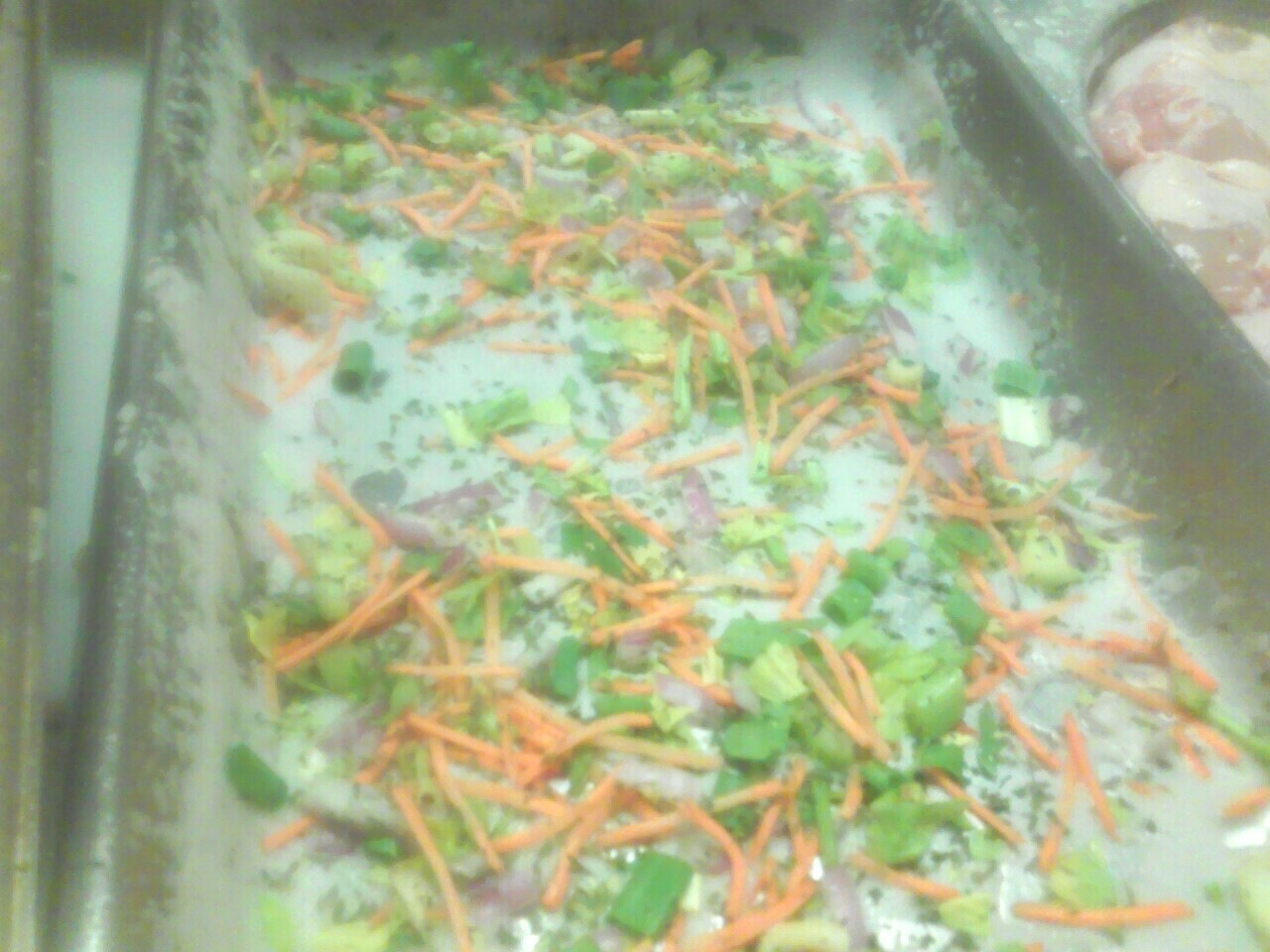
David breaded and fried the chicken while I chopped and prepared a mirepoix of Onion, Green Onion, Carrots, and Celery.  Most of the vegetables for the mirepoix were already prepared as we used them from the salad bar.  Though we were out of celery and this I had to prepare.

Once my vegetables were prepared, I took the restaurant pans, sprayed them down with pan release, sprinkled about 3/4 to 1 cup of mirepoix into the bottom of the pans and placed my chicken pieces into the pans.  Due to lack of pan space, I had to crowd the chicken pieces, normally when baking chicken pieces you would leave space between the pieces.


I then put another cup or so of the mirepoix over the chicken with a 1/4 cup of chicken broth and covered the pans with heavy aluminum foil.


 Covering the pans, I then baked them for 40 minutes at 350 degrees farhenhiet and then uncovered the pans and baked an additional 20 minutes.


The recipe that I based my preparation of this Baked Chicken was Roast Chicken with Pan Gravy.  Starting with my Mirepoix of Onion, Green Onion, Carrots, Celery and freeze dried parsley.  I added a dusting of the Schnuck's Herb Roasted Chicken Seasoning, more of the mirepoix and a 1/4 cup of chicken broth.


Saturday, December 3, 2011

Aromatic Flavoring Combination Guidelines from Culinary Fundamentals

Aromatic Flavoring Combination Guidelines

Source: Culinary Fundamentals  Pg 283
Copyright: Prentice Hall

(Each recipe is enough to flavor about 1 gallon of finished product.)


Yield
Standard Sachet d’Espices
Standard Bouquet Garni
Mirepoix
1 sachet
1 bouquet
1 pound
Onion
-
-
8 oz, diced
Carrot
-
-
4 oz, diced
Celery
-
4 oz, whole stalk
4 oz, diced
Leek
-
2 or 3 leaves
-
Parsnips
-
-
-
Mushroom
-
-
-
Bacon or Raw Ham
-
-
-
Parsley
3 or 4 Stems
3 or 4 stems
-
Thyme
½ tsp dried leaves
1 fresh sprig
-
Bay Leaf
1 leaf
1 leaf
-
Peppercorns
½ tsp, cracked
-
-
Garlic
1 clove, crushed (optional)
-
-

Yield
White Mirepoix
Matigon

1 pound
1 pound

Onion
4 oz, diced
2 oz, small dice

Carrot
-
4 oz, small dice

Celery
4 oz, diced
4 oz, small dice

Leek
4 oz, diced
2 oz, small dice

Parsnips
4 oz, diced
-

Mushroom
2 oz, trimmings (optional)
2 oz, small dice (optional)

Bacon or Raw Ham
-
2 oz, small dice

Parsley
-
-

Thyme
-
-

Bay Leaf
-
-

Peppercorns
-
-

Garlic
-
-


           White Mirepoix
·         Used to flavor white stocks and soups that should have a pale ivory or white color.
·         Parsnips replace carrots.
·         Leeks can replace some or all of the onions.

Matigon (math-in-YOHN)
·         Includes onions, carrots, celery, and raw ham cut into uniform dice.
·         Mushrooms and assorted herbs and spices may be added as desired.
·         Sweat in butter and deglaze with wine.
·         Since matigon is added to a dish both as a flavoring and as a garnish, it is not strained out of the dish. It is sometimes called edible mirepoix.

Cajun Trinity
·         Made up of a combination of onions, celery, and green pepper.
·         Used in many Louisiana Creole and Cajun dishes, such as gumbo.

Battuto (bah-TOOT-oh)
·         Includes olive oil or chopped lard, pancetta, or fatback, with garlic, onions, parsley, carrots, celery, and/or green peppers.
·         Used in Italian soups, sauces, stews, and meat dishes.
·         Once sautéed, a battuto becomes known as a soffritto.


Mirepoix will add a distinct aroma to a dish, even if the cut up vegetables are simply added to the pot as it simmers. But sweating, smothering, or browning (pincage) them in fat significantly changes the flavor.

Brown Veal Stock from Culinary Fundamentals

The American Culinary Federation


Yield: 4 quarts


Categories: Soup

Source: Culinary Fundamentals pg. 312
Copyright: Prentice Hall


Brown Veal Stock from Culinary Fundamentals


4 fluid ounces Oil
8 pounds Veal bones, including knuckles and trim
6 quarts Cold water
1 pound Mirepoix
6 ounces Tomato paste
1 each Sachet d'épices

1. Condition the roasting pan: Heat the pan and enough oil to lightly film the pan in a 425° to 450°F/220° to 230°C oven. Add the bones to the pan and return to the oven. Roast the bones, stirring and turning from time to time, until they are a deep brown, about 30 to 45 minutes.

2. Transfer the bones to a stockpot and add all but 1 cup of the cold water. Deglaze the roasting pan with 1 cup of water and add the released drippings to the stockpot. Bring the stock to a simmer slowly over low heat. Adjust the heat if necessary to establish an even, gentle simmer and continue to cook, skimming the surface as necessary, for about 5 hours.

3. While the stock is simmering, heat a medium-size rondeau over medium-high heat. Add enough oil to film the pan. Add the mirepoix and cook, stirring occasionally, until the onions are a deep golden brown, about 15 to 20 minutes. Add the tomato paste and continue to cook, stirring frequently, until it takes on a rusty brown color and gives off a sweet aroma, about 1 to 2 minutes. Add a few ladles of the stock to the rondeau and stir well to release the drippings; add this mixture to the stock along with the sachet at the same time.

4. Continue to simmer the stock, skimming as necessary and tasting from time to time, until it has developed a rich flavor and a noticeable body, about 1 more hour.

5. Strain the stock. It may be used now (degrease by skimming if necessary), or it may be rapidly cooled and stored for later use.

Notes: VARIATIONS:

Brown Game Stock (Jus de gibier) – Replace veal bones with an equal amount of game bones. Include fennel seeds and/or juniper berries in a standard sachet d'épices.

Brown Lamb Stock (Jus d'agneau) – Lamb stock can be flavored with one or more of the following herbs and spices in a standard sachet dépices: mint stems, juniper berries, cumin seeds, caraway seeds, rosemary.

Brown Pork Stock (Jus de porc) – Stock made with fresh or smoked pork bones is often used as an ingredient in bean or potato dishes or pork- or ham-based soups. Add one or more of the following herbs and spices to a standard sachet d'épices: oregano stems, crushed red pepper, caraway seeds, mustard seeds.

Brown Chicken Stock (Jus de Volaille) – Replace the veal bones with an equal weight of chicken bones and lean trim.

Brown Duck Stock (Jus de Canard) – Replace the veal bones with an equal weight of duck bones and lean trim (or bones of other game birds, such as pheasant). Include fennel seeds and/or juniper berries in a standard sachet d'épices, if desired.

Friday, December 2, 2011

Roast Chicken with Pan Gravy

The American Culinary Federation


Servings: 10

Categories: Main Dish

Source: Culinary Fundamentals pg. 460
Copyright: Prentice Hall


Roast Chicken with Pan Gravy

5 each Chickens
Salt, as needed
Black pepper, as needed, freshly ground
5 each Thyme sprigs
5 each Rosemary sprigs
Vegetable oil or butter, as needed
4 ounces Onion, diced
2 ounces Carrot, diced
8 ounces Celery, diced

Pan gravy
2 ounces Flour
1/2 ounce Tomato paste (optional)
1 pint Chicken Stock, hot

1. Remove the wing tips from the chickens and reserves. Season the exterior and the cavity of the chickens with salt and pepper and place one sprig of thyme and rosemary in each cavity. Rub the skin with oil and truss each chicken with twine.

2. Place the chickens, breast side up, on a rack in a roasting pan. Scatter the wing tips in the pan.

3. Roast at 400°F for 40 minutes, basting from time to time. Scatter the mirepoix around the chicken and continue to roast another 30 to 40 minutes or until the thigh meat registers 180°F. Transfer the chickens to a holding pan, cover loosely, and allow them to rest while preparing the pan gravy.

4. Place the roasting pan on the stovetop and cook until the mirepoix on the stovetop and cook until the mirepoix is browned and the fat is clear. Pour off all but 1 once of the fat. Add the flour and cook out the roux for 4 to 5 minutes. (Optional: Add the tomato paste to the roux and cook out 2 minutes more,) Whisk in the stock until completely smooth. Simmer the gravy for 20 to 30 minutes, or until it reaches the proper consistency and flavor. Degrease and adjust seasoning. Strain through a fine mesh sieve and keep warm for service. Cut the chickens into portions and serve with pan gravy. 

Nutritional Information per Serving (excluding unknown items): 1639 Calories; 117g Fat (65.6% calories from fat); 130g Protein; 8g Carbohydrate; 1g Dietary Fiber; 679mg Cholesterol; 544mg Sodium. Exchanges: 1/2 Grain (starch); 18 Lean Meat; 1/2 Vegetable; 12 Fat

Roast Loin of Pork from Culinary Fundamentals


The American Culinary Federation


Servings: 10

Categories: Main Dish

Source: Culinary Fundamentals pg. 468
Copyright: Prentice Hall


Roast Loin of Pork

6 pounds Pork Loin, bone in
Salt, as needed
Pepper, as needed
1 teaspoon Rosemary leaves
1 teaspoon Sage leaves
12 ounces Mirepoix
2 ounces Flour
1 quart Pork or Chicken Stock (see Brown Veal Stock variations), hot

1. Remove the chine bone, leaving the ribs in. Remove the tenderloin for other use. Place the pork in a greased roasting pan; rub the outside with the salt, pepper, and herbs. (You can buy a boneless Pork Loin, this would make the need to complete this step unneeded.)

2.     Tie the loin in order to get uniform cooking and better presentation.

3. Sear the Loin to lock in juices with about 2-3 Tablespoons of Vegetable Oil 

4.     Place the pork in a preheated 350°F oven. Roast it for 1 hour. Turn the loin and continue to roast 1 hour.

5. Add the mirepoix and roast until the pork has an internal temperature of 150°F. Transfer the roast to a hotel pan, cover loosely, and let rest in a warm place.

6. Pour about 2 ounces of fat from the roasting pan into a saucepan, and the flour to make a roux. Cook the roux over low heat for about 10 minutes to brown it lightly.

7. Place the roasting pan on a range. Scrape it to loosen the browned drippings. Simmer the stock until the mirepoix is tender, strain it, and bring it to a boil again. Degrease the pan. Add the stock to the cooked roux and stir the mixture, until it is thickened and smooth. Strain through a fine china cap and adjust the seasoning to taste. Hold the gravy for service. Slice the meat between the ribs and serve it with 2 ounces of gravy poured around the meat. 

Nutritional Information per Serving (excluding unknown items): 298 Calories; 12g Fat (38.0% calories from fat); 35g Protein; 9g Carbohydrate; 2g Dietary Fiber; 85mg Cholesterol; 122 mg Sodium. Exchanges: 1/2 Grain (starch); 5 Lean Meat, 1 Vegetable; 1/2 Fat.